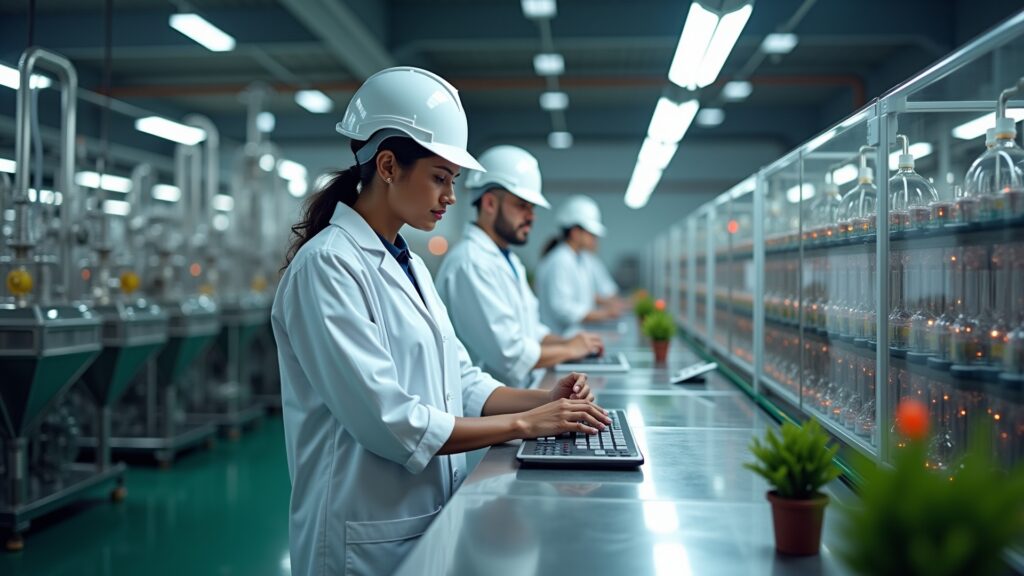
As a leader or key decision-maker in the chemicals industry, you recognize that operational excellence and strategic agility are no longer optional but essential for sustained growth. The rise of AI-driven manufacturing in India’s chemicals sector is more than a technological upgrade—it represents a fundamental shift that can transform your business models, enhance your competitiveness, and redefine how you engage with global markets.
You are at the crossroads where integrating artificial intelligence into your manufacturing processes can unlock unprecedented efficiencies and open new avenues for strategic expansion. Understanding how AI is reshaping the Indian chemicals industry is key to making informed decisions that bolster your operational resilience and profitability in an environment marked by fierce global competition and regulatory complexity.
Why AI-Driven Manufacturing Matters to You
The chemicals sector in India operates within a dynamic matrix of volatile feedstock prices, stringent environmental standards, and shifting international trade dynamics. AI-powered manufacturing stands out as a tool that not only addresses these challenges but also leverages them into opportunities for growth. Your ability to harness AI technologies directly impacts your capacity to improve product quality, optimize production schedules, and enhance supply chain responsiveness.
Moreover, AI’s integration facilitates real-time data-driven decisions that empower you to anticipate market fluctuations and fine-tune resource allocation. This capability is critical in specialty chemicals and petrochemicals segments where precision in manufacturing leads to superior product performance and better alignment with global customer expectations.
The Landscape of AI Adoption in India’s Chemicals Industry
The adoption of AI in the Indian chemicals sector is accelerating, particularly in:
- Process optimization: AI algorithms analyze real-time production data to improve yields and reduce waste.
- Predictive maintenance: Early fault detection through AI reduces downtime and extends equipment lifespan.
- Quality control: Automated AI inspections ensure consistent product quality to meet stringent regulatory and customer standards.
- Supply-chain forecasting: Advanced analytics help navigate feedstock variability and logistics complexity.
This shift is pivotal for companies aiming to meet the increasing global demand for specialty chemicals and petrochemicals with sustainable, cost-effective production practices.
Strategic Implications for Your Business
Incorporating AI-driven manufacturing techniques is not simply about automation; it is about enabling a transformative business strategy that you can leverage to withstand margin pressures and achieve operational excellence. With better forecasting and adaptive control systems, you can optimize feedstock usage and adjust rapidly to changing demand cycles, enhancing your competitive position.
From an export standpoint, AI enables the production of globally compliant, high-quality chemicals, reinforcing India’s positioning as a China+1 alternative. You gain enhanced capabilities to address the complex compliance landscapes of international markets, particularly in Europe and North America, where sustainability criteria and process transparency are increasingly critical.
“The real edge is not only in producing more, but in producing smarter, cleaner, and closer to where demand is shifting.”
Driving Sustainability with AI
Sustainability is no longer a peripheral consideration but central to your industry’s strategic roadmap. AI empowers you to track and optimize energy consumption, reduce waste streams, and implement circular economy principles more effectively. Monitoring emissions and process variations through intelligent systems aligns your operations with tightening environmental regulations and corporate ESG goals.
Aligning with national initiatives on chemical park development and digital transformation, your adoption of AI-driven manufacturing positions you to benefit from policy incentives and manufacture within ecosystems designed for rapid innovation and sustainability.
Deeper Strategic Insights
AI drives a paradigm shift in how you balance capital allocation between capacity expansion and process innovation. Investing in AI platforms can improve manufacturing economics by increasing throughput and reducing costs tied to downtime and feedstock inefficiencies. It drives portfolio rationalization by highlighting high-margin products and operational bottlenecks, facilitating smarter capital deployment.
In addition, AI-enhanced supply chain analytics allow you to mitigate risks associated with freight volatility and raw material unpredictability, reinforcing your supply resilience and export reliability.
“When feedstock strategy, manufacturing efficiency, and market timing align, chemicals growth becomes far more defensible.”
Key Practical Takeaways for Chemicals Leaders
- Understand: AI is a strategic enabler—view its adoption as a core component of your operational and business strategy, not just a technology upgrade.
- Monitor: Track advancements in AI applications across process optimization, quality assurance, and supply chain intelligence to stay ahead.
- Act: Invest in workforce training to build AI literacy and ensure smooth integration with existing manufacturing processes.
- Engage: Collaborate with technology providers and leverage government initiatives promoting industry digitalization and chemical park ecosystems.
- Evaluate: Prioritize projects with clear ROI and scalability potential, focusing on areas like predictive maintenance and real-time quality control.
Challenges on the Horizon
You need to be cognizant of the challenges that accompany AI adoption. Workforce readiness remains a critical barrier; upskilling your employees to work effectively with AI tools is essential. Integration complexities between legacy systems and new AI platforms can slow progress and require careful change management. Initial capital outlays for AI implementation may strain budgets if not justified by strategic planning and detailed business cases.
Yet, navigating these challenges strategically presents an opportunity to build a more resilient, agile, and efficient manufacturing base—one well-poised for future growth.
What You Should Watch Closely Next
- The evolution of AI capabilities tailored specifically for petrochemical and specialty chemical manufacturing needs.
- Regulatory developments linked to digital compliance, data security, and environmental impact reporting that affect AI implementation.
- Government policies enhancing incentives for smart manufacturing and digital infrastructure investments within chemical parks.
- Global market shifts, including China+1 sourcing trends and new export opportunities emerging from AI-enabled quality and supply chain improvements.
Conclusion: Embrace AI-Driven Manufacturing to Future-Proof Your Chemicals Business
As AI-driven manufacturing gains traction in India’s chemicals industry, your strategic engagement with this transformation will define your growth trajectory and competitive standing. It is essential to view AI not as a peripheral innovation but as a core pillar that supports smarter decision-making, sustainability commitments, and export excellence.
By integrating AI thoughtfully and purposefully, you position your company to thrive amid uncertain geopolitics, fluctuating feedstock economics, and escalating global standards. The chemicals industry in India is entering an era where manufacturing prowess is measured not just by scale, but by intelligence and adaptability—and your business should be at the forefront of this evolution.
“In the chemicals industry, resilience is built as much through procurement and process discipline as through scale.”